
KPI dashboard design: 10 metrics agencies should show to their clients
To succeed in the digital marketing world of 2026, you need to track the right metrics. Discover the 10 critical KPI dashboard metrics your agency should provide you.
Do you feel like you are drowning in a sea of data while looking at that complex PDF report your agency sends at the end of each month? Your advertising budget is being spent, clicks are increasing, charts are pointing upward; however, can you never quite figure out how the net profit entering your cash register reflects in these tables at the end of the day? If you have started asking yourself, "We got a lot of clicks this month, but why aren't the phones ringing?" the issue may not be in your agency's work, but rather in what and how they are reporting to you.
The world of digital marketing has become too sophisticated to be managed only with superficial metrics like "clicks" or "impressions" by 2026. As a business owner, what you need now is not a pile of data, but actionable insights. In this guide, we will delve into 10 critical KPIs (Key Performance Indicators) that a digital marketing agency should provide you, which directly impact the future of your business, and how these metrics should be integrated into a modern dashboard design.
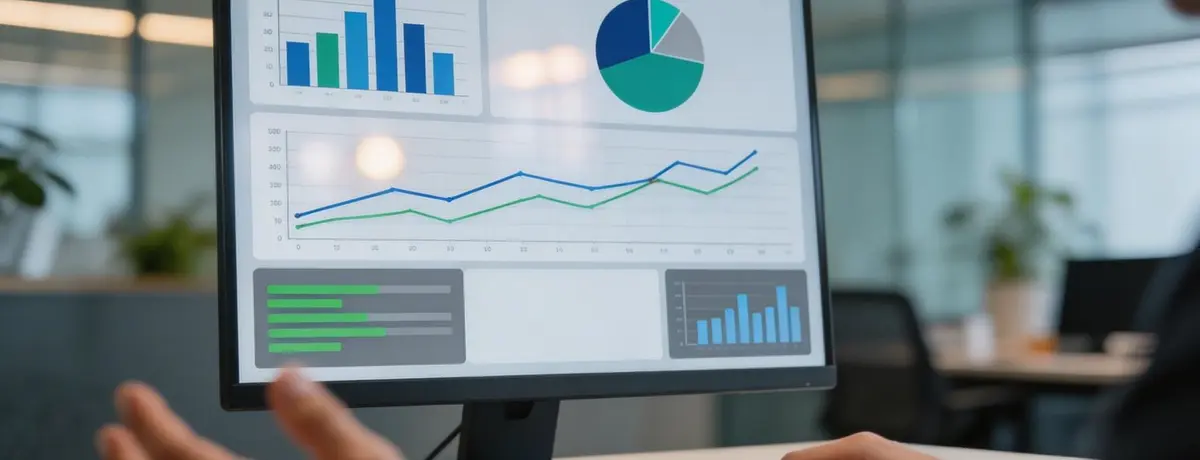
Modern digital marketing KPI dashboard screen
What is KPI Dashboard Design?
KPI dashboard design is the integration of the most critical data sets (KPIs) that indicate a business's progress towards its digital marketing goals, displayed in real-time on a visual panel. By 2026 standards, these designs offer user-friendly and interactive interfaces that enable decision-makers to quickly make strategic moves by simplifying complex raw data.
In practice, we often see this: Many agencies report to their clients simply by presenting screenshots taken from Google Ads or Meta dashboards. However, a professional approach requires combining data from different channels into a single pot and aligning it with business goals. For example, if we had only looked at the ROAS value on the advertising panel for our e-commerce client, we would have never seen how the return rates were eroding profitability. Therefore, dashboard design should show not only "what is happening," but also "why it is happening."
Professional Tip: Apply the "3-second rule" when designing your dashboard. A manager should be able to understand within 3 seconds whether things are going well (with color codes or trend arrows) when looking at the panel. If it takes minutes to understand, that design is faulty.
The Evolution of Data in 2026: Why Standard Reports Are No Longer Enough?
In past years, an agency's success was measured by lowering "Cost Per Click (CPC)." However, in 2026, we are in an ecosystem dominated by AI-powered advertising models and privacy-first data tracking. Technical requirements, such as GA4 Consent Mode V2 setup, have changed the kitchen of data. In a world without cookies, dashboard designs that can model lost data are not a luxury but a necessity.
Based on our experience working with clients, the biggest deficiency of standard reports is their lack of a "Business Intelligence" vision. A dashboard should not only narrate the past but also whisper potential future scenarios by leveraging the predictive analytics power of 2026. You can create a basic Google Looker Studio report; however, establishing a bespoke structure that blends your data with your CRM data makes a difference.
Professional engaging in interactive data analysis on a tablet
10 Critical Metrics Agencies Should Show to Their Clients
The metrics you should demand when working with an agency determine whether the agency is merely a technical executor or a strategic business partner. Here are those 10 metrics that define the 2026 agency reporting standards:
1. ROAS (Return on Advertising Spend)
ROAS is the most fundamental indicator of success in advertising panels. However, in 2026, we see this not just as "Revenue / Spend." You should definitely see the distinction between "New Customer ROAS" (nROAS) and "Existing Customer ROAS" on your dashboard. To understand how efficient your ads are, you should track the impact of your Google advertising strategies on this metric.
2. MER (Marketing Efficiency Ratio)
One of the metrics that is often overlooked in the industry but we value the most is MER. This ratio, obtained by dividing total revenue by total marketing expenses, gives you an overhead view of profitability. Since the data in advertising panels is not 100% accurate (due to cookie restrictions) during this period, MER is your compass.
3. CLV (Customer Lifetime Value)
Without knowing how much a customer will bring you over their lifetime, you cannot decide how much you can spend to acquire a customer today. A professional agency should also report the loyalty and repurchase rates of acquired customers over time in the dashboard design.
4. CPA (Cost Per Acquisition)
What is the cost of acquiring a new customer or a lead? In an analysis we conducted at an industry-leading firm, by tracking how the CPA rate fluctuated over time, we shifted the budget to low-cost weeks and achieved a 30% increase in efficiency. You should see this metric separately for each channel (Meta, Google, TikTok).
5. Conversion Lag Time
How many days after a user clicks your ad do they make a purchase? In 2026, purchase journeys are much more complex. If your product is high-priced, the decision process could take 15-20 days. If your dashboard does not reflect this process, you might think that the campaign your agency started 3 days ago is failing; however, that campaign will bear fruit in 2 weeks.
6. First-Party Data Growth Rate
In this era where cookies are coming to an end, data like the number of emails on your list, the number of SMS opt-in users are worth their weight in gold. You can measure whether your agency is not just generating sales but also accumulating data assets with this metric.
7. Share of Search
What portion of the total search volume in your industry is related to your brand? This metric is the clearest reflection of your market share in the digital space. Tracking the increase in this share while receiving SEO services is the real proof of your brand awareness.
8. Assisted Conversions
Some channels may not score the goal, but they assist. For example, a user discovers you through a YouTube ad (assist) and then comes through Google to make a purchase (goal). If you do not see the channels that make the assist in your dashboard design, you may make the mistake of cutting the budget saying, "YouTube is not working," which will lower your overall sales.
9. Brand Sentiment Score (AI-Powered)
In 2026, thanks to artificial intelligence, we are now adding "sentiment" data from social media comments to our dashboards. What percentage of what is said about your brand is positive, and what percentage is negative? This metric is vital for crisis management.
10. pROAS (Predictive ROAS)
Imagine a metric that predicts what your end-of-month ROAS will be based on current data using artificial intelligence models. Adding these predictions to your dashboard with AI data analysis tools gives you remarkable flexibility in budget management.
Traditional Reporting vs. Strategic KPI Dashboard
The table below clearly summarizes why you need a comprehensive dashboard design instead of a simple report:
Özellik Geleneksel Raporlama (Eski Usul) Stratejik KPI Dashboard (212 Medya Standartı)
Veri Güncelliği Ayda bir kez, geçmiş verilerle. Anlık (Real-time), 7/24 erişilebilir.
Odak Noktası Tıklamalar, Gösterimler, CPC. Karlılık, MER, CLV, pROAS.
Analiz Derinliği Yüzeysel ve sadece panel verisi. CRM entegreli, omni-channel analiz.
Gelecek Öngörüsü Yok (Sadece ne olduğunu anlatır). Var (AI destekli trend tahminleri yapar).
Karar Verme Hızı Yavaş (Raporun gelmesi beklenir). Hızlı (Anlık veriyle anında aksiyon).
Application Suggestion: Ask your current agency or marketing team to add at least 3 of the "Strategic" features listed in the table above to your dashboard. If their infrastructures are not suitable for this, it indicates that the time for a technological transformation has come.
5 Critical Mistakes Commonly Made in Dashboard Design
Based on our experience working with clients, the incorrect presentation of data leads to wrong decisions. Here are the mistakes to avoid:
- Data Vomit: Filling the panel with unnecessary hundreds of graphs. Remember, less is more valuable.
- Lack of Context: Presenting data without comparing it to the previous month or the same period last year. Is a 10% increase good? If the market has grown by 50%, a 10% increase is actually a failure.
- Visual Hierarchy Disorder: Having the most important metric (e.g., Net Profit) at the bottom of the page while placing trivial metrics (e.g., Instagram follower growth) at the top.
- Mobile Compatibility Issue: Managers often check their dashboards from their phones while on the go. If the design does not work on mobile devices, it is a significant shortcoming.
- Use of Technical Jargon: The report should be prepared not only for advertisers but also for business owners. There should be brief and understandable explanations (tooltips) alongside every metric.
Manager reviewing a mobile-compatible dashboard
Turn Data into Profit with 212 Medya
The right KPI dashboard design is like the difference between navigating in the dark by feel and walking towards a target with night vision goggles. At 212 Medya, we do not just present numbers to our clients; we unveil the commercial potential behind those numbers. By utilizing Google Looker Studio, Power BI, and custom software integrations in our data visualization processes, we create a transparent structure where you can instantly monitor all the digital muscles of your business.
You can collect data from every panel at a basic level; however, transforming this data into strategic weapons requires technical expertise and deep industry experience. To stay a step ahead of your competitors in the competitive market of 2026, you should choose to manage data, not just read data. Our expert team is always by your side to create the right dashboard structure for your brand and to manage your advertising budget with maximum efficiency.
Key Points
- KPI dashboards should be real-time and accessible 24/7.
- Focus should be on profitability metrics like ROAS and MER instead of metrics like clicks and impressions.
- Predictive analytics, such as pROAS, which is a trend for 2026, should be included in the strategy.
- First-party data (CRM) growth should be reported as an integral part of advertising success.
- Dashboard design should comply with the "3-second rule," be simple, and mobile-compatible.
- Not only primary conversions but also assisted conversions (assist channels) should definitely be tracked.
Frequently Asked Questions
What tools should be used for a dashboard design?
In 2026, the most commonly used tools are Google Looker Studio, Microsoft Power BI, and Tableau. For small and medium-sized enterprises, Looker Studio offers the most efficient solution in terms of cost and integration, while Power BI may be preferred for massive data sets.
Does my agency's report only having Google Ads data sufficient?
Absolutely not. Google Ads data alone is only part of the picture. You should demand an "omni-channel" dashboard that integrates the data from Meta, TikTok, SEO, and even your offline sales (CRM).
Why is conversion tracking so crucial for the dashboard?
If there is no proper tracking infrastructure (e.g., Server-Side Tracking) in place, the data you see on your dashboard may be as much as 30% inaccurate. Accurate decisions cannot be made with faulty data. Advertising without setting up tracking, is like driving blindfolded.
Are dashboard setup costs high?
The setup cost varies depending on the complexity of the data and number of channels to be integrated. However, it is not an expense but the most critical investment that prevents your advertising budget from being wasted and increases your ROI.
Can I create my own dashboard?
Yes, you can establish a basic structure using tools like Google Looker Studio. However, for data blending, advanced metric calculations, and the technical requirements of 2026 (API connections, AI models), obtaining professional agency support is critical for the accuracy of the results.
The path to success in digital lies in measurable and manageable data. If you want to see the digital X-ray of your business in real-time and base your strategy on data, contact the 212 Medya team now and let’s design a dashboard solution just for you.